We have put together our list of the best 10 films of the year as well as handing out some slightly dubious awards. Now that you've heard this gem of film criticism you can skip the Academy Awards. And at 4 hours it's only half as long.

Thursday, 20 February 2014

Saturday, 25 January 2014
Imitation of Life: What Delightfully Subtle Sati- MY EMOTIONS!
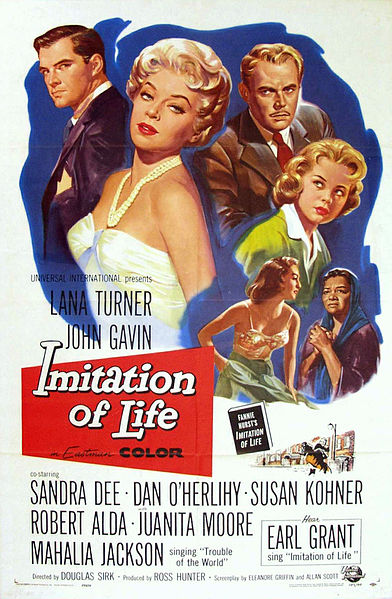
The colour palette here isn't as stunningly over the top as All That Heaven Allows because the relatively strong script doesn't require cinematic showmanship to carry it along. Instead Sirk pulls a cunning narrative bait-and-switch, starting to tell us the story of aspiring actress Lora Meredith (Lana Turner) before trailing off into the tortured lives of submissive black maid Annie Johnson (Juanita Moore) and her fair-skinned daughter Sarah Jane (Susan Kohner). As the "struggles" of Lora become more inane and materialistic the plot line involving the black characters becomes darker and more visceral. In his final Hollywood film, Sirk slowly peels off the glossy veneer he'd brilliantly disguised his films with earlier to tell one of the most viciously honest stories of contemporary racism in America. Sirk never made another Hollywood film, and although this film had nothing to do with it (in so far as not provoking significant controversy) it's thrilling to see one of Old Hollywood's most cunning, considered and pragmatic directors kick off his heels and lay into the broken and vacuous culture that had nurtured him.
Sunday, 4 August 2013
Spring Breakers: Never Mind The Subtext... Here's Some Sex & Pistols

When Spring Breakers was released a few months ago, the baited breath that accompanied it was divided between the tabloid culture that built these tarnished Disney princesses and jaded, snobby film buffs. The people in the middle were left confused as to exactly what the hell was so special. With it's gaudy promotional material, stunt casting and R18+ rating, Spring Breakers confused many as to who exactly it was trying to please. There was a general consensus that this film mattered but few could exactly say why. Is there a fanciful morality tale at the core? Broad cultural satire? Subtle undercurrent of pathos? No, there's none of that. The movie comes exactly as advertised and then some. But my God does Korine know how to hold a camera.
The shots and there unique colour schemes are so hypnotically engaging and creative. Korine manages to fuse the hues of a night club light, lip gloss, bright bikinis and hair streaks to create an irresistible palette. The film is almost entirely composed of a contrast between drab decaying buildings and off-puttingly bright pinks and yellows. It's the kind of aesthetic that, on paper, makes you want to throw up but I can't state enough how well it works. When the film starts it slowly coasts through the familiar territory of small-town banality before it makes the inevitable shift towards the non-stop nudity and liqueur of Girls Gone Wild style partying. Both settings are familiar territory but Korine finds ways to make the fresh again, which is particularly amazing considering how many lame spring break montages have cluttered up film and television. The film's greatest moments are reserved for the third act though, where everything descends into a surreal mashup between Scarface and a Britney Spears video. If you think that that analogy sounded strained, don't blame me, the comparison between those two cultural icons is made explicit in the film.
There's little to decode or analyse here and if there is it doesn't feel sufficiently thought out or compelling enough to focus on. It's mainly about the visceral fun of the characters and the viewer. It's best expressed by the girls' voice-mail messages to their mothers and grandmothers, a device that may strike some as contrived but nicely underscores the whole experience. They described their time in Florida in religious, sophisticated terms and the first assumption is that they're just lying to shield their reputation. But the praises they sing about their absurdly over-the-top Florida holiday is completely sincere because there is something completely transcendent about this pink-hued, blood-splattered, T&A filled road trip. It's a glorious tribute to hedonism that doesn't shy away from the inherent ugliness that comes with it. But don't confuse it for a critique; that would defeat the purpose.
Friday, 19 July 2013
Breaking Bad Podcast... Bitch!
So we've started a little sub cast in celebration of the upcoming end of television masterpiece Breaking Bad. We're blasting through the first 41/2 seasons before doing weekly looks at the new episodes. If you subscribe to the podcast then you'd have noticed the first episode is up and the rest are going to be uploaded to the designated feed: Cavaliers Break Bad. So search that in iTunes, or whatever you use, and here's the first episode.
Tuesday, 2 July 2013
Cavaliers Do Television Now!
As the final eight episodes of Breaking Bad are scheduled to begin soon, we wanted to celebrate with a look back at the entire series in a few podcasts before tackling the new episodes as they air. The first of those episodes will be uploaded soon but in the mean time I've decided to create a sister site Cavaliers Do Television. You can find it on the toolbar at the top and at the moment there is only a review of the recent season of Mad Men. I plan to give weekly reviews of the final (thank god) season of Dexter and as I'm marathoning through Game of Thrones expect a season-wide review of the three that have aired. This is all terribly main stream I know but hopefully I'll take a look at some more niche favourites later on.
Wednesday, 13 February 2013
Salo, or the 120 Days of Sodom: A Barrel of Shit-Smeared Laughs

Watching the film now, with all the hype surrounding it, the most stressful aspect is perhaps the idea that you won't be traumatised enough. Watching the brutality and depravity on display, it feels like any response short of vomiting and crying would make me an unfeeling monster. Austrian moralist director Michael Haneke would probably brow-beat me for displaying any emotion other than disgust. However as distressing and terrifying as the film is, it is not quite as shocking and horrifying as it's reputation. There's something more sinister beyond that.
Pasolini uses the Marquis De Sade's outpouring of id in the face of oppression and applies it to corrupt contemporary Italian politics and the legacy of Mussolini's fascism. Unlike the unconvincing political metaphor's of grizzly movies like Hostel and A Serbian Film, Salo draws a very clear and immediate connection between the depicted depravity and it's political themes, lending credence to the theory that Pasolini was politically assassinated. The film is a period piece about the end of fascist Italy and the sadistic men of power wax lyrical about political and moral philosophy while raping and torturing teenagers. There's no subtlety at play: Pasolini plays out the opulent and selfish indulgence of fascism (and perhaps a corrupt capitalist state) to it's most hideous extreme. The film is much more powerful for this reason and the content is so vile and off-putting that no subtlety would be able to escape anyway.
Salo is divided into four chapters, with the first dedicated to rounding up the doomed youth and the rest detailing their fates. The Circle of Manias is the most overtly sexual, filled with humiliating mind games and almost erotic acts of teasing. Things kick up a notch in the Circle of Shit where things turn to... shit.
In the most infamous scene of the film, a girl is punished for mourning her dead mother by being forced to eat faeces. It's an extremely distressing moment, the camera not pulling away for discretion and the girl exhibiting the most human outburst of misery in an otherwise cold film. After this point there is nowhere to go, I could not be disturbed by anything else Pasolini had to throw at me, and he had a lot. In the climactic Circle of Blood, the rape and torture is seen through the binoculars of the far-removed men of power, nicely capturing the audiences detachment in the moment. The victims, the perpetrators, Italy as a whole and even the viewer lost their humanity about half way through, so the absurdly brutal finale feels inevitable and unimpassioned. This is why Salo is one of the most effective depictions of dehumanisation, it really takes the audience into it's perverted world.
There's a lot more to Salo then can be summarised here and it is definitely a film worth seeing if you can stomach it. Perhaps the most perverse thing is, I feel I should one day watch it again.
Download This Podcast Motherfucka! I Dare You, I Double-Dare You
In an effort almost as long and profane as the Kill Bill saga we take a look back at the complete ouvre of Quentin Tarantino. In the spirit of his self-aggrandizement we declare that the result is 'kick-ass'. We hope you enjoy because we had to fight Miramax to keep the run-time this long.
Thursday, 7 February 2013
Blow Out: Stop Being Mean To De Palma

De Palma essentially redoes Blow Up via The Conversation while layering on his own love of voyeurism and meta-commentary. The film is relentless in it's deconstruction of cinema as a medium but he wisely chooses to use cheap exploitation trash as his starting point. We start with a ludicrously T&A filled slasher film that faithfully recreates the genre fare of the time, while simultaneously rising above it thanks to De Palma's skilled use of the long-take. We then meet John Travolta's sound engineer protagonist, who must find the 'perfect scream' for his sleazy producer. As he goes to collect ambient sounds for the film he witnesses, intervenes in and records the most sensational political crime/scandal imaginable.
From there the film manages to stage one scenario after the other where the manipulation and unraveling of the relationship between sound and vision are key to solving the central mystery. It's a clever trick that is executed by a director at the top of his game. What makes Blow Out so satisfying is that the superficial sophistication of Blow Up and The Conversation are disposed of as we are surrounded by images of urban sleaziness and B-movie schlock. Meanwhile, the central mystery plays out as the most sensationalist culmination of Watergate, the Kennedy assassination and Chappaquiddick. This let's the films true intelligence seep in through the cracks as De Palma's broader points works with, instead of against, the popcorn thriller on the surface.
Deep Red: Pure Italian Insanity
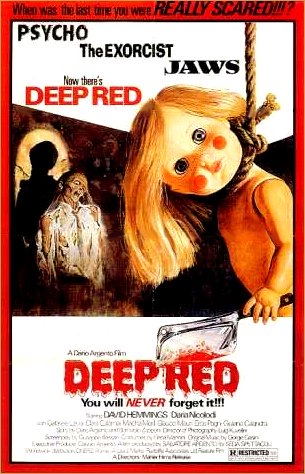
The reason for Argento's brilliance is that he essentially has directorial ADD: if the camera isn't moving then the shots must be edited into oblivion. While horror films tends to drop their bells and whistles when the carnage stop and the exposition starts, Argento keeps his visual flare during the most prosaic scenes, which take up a large chunk of the movie. What makes Deep Red so continually fascinating and at times unsettling is the sincerity of it's lunacy. This isn't the self-conscious rule breaking of Godard and co. but the presence of a true maniac behind the camera. Yet somehow Argento is a master of composition, nothing in the mis en scene feels amateurish even while everything else in the movie does. This feels like the product of a cinema idiot savant, Argento doesn't know how to be effective he just is.
Deep Red is not as strong as it's follow up Suspiria, a truly terrifying film that features more memorable set-pieces because the camera's actions here are often more compelling than what it's capturing. However as ludicrously convoluted and poorly paced as the 'mystery' is there are moments of genuine horror and suspense. Argento's extraordinarily unhinged directing may work grandly on tightly written, well acted film but we'll never know. Instead it's best to accept that all the clunky components actually aid the creation of an amazing piece of cinematic anarchy.
*The reason for the language switch is because of the way the film was put together for it's DVD release. The film restored about 20 minutes of deleted scenes that had never been dubbed so the producers simply slapped it onto the English dub without giving any thought to the idea that perhaps the viewer may want other options. You can now find the shortened English cut and the extended Italian cut on DVD and Blu-Ray, however with foreign pulp it always feels best to be watching the version that has resulted from a series of insane production decisions.
Review: Silver Linings Playbook

David O. Russell is a nutter. Anybody who's seen Spanking the Monkey or I Heart Huckabees knows that. In particular, anybody who's seen his outburst at Lily Tomlin on the set of I Heart Huckabees knows that (seriously, if you haven't seen it, GET ON IT http://www.youtube.com/watch?v=E4Qls1rAfYs). I loved I Heart Huckabees, something about the completely absurd nature of it all. Something about Isabelle Huppert and Jason Schwartzman making out in the mud. Something about Naomi Watts acting the shit out of discovering her existence. I Heart Huckabees shows what film can be when continuity of a diegetic reality is prioritised over it's verimisimilitude. However it does of course have it's flaws, it's a pseudo-philosophical comedy of 90 minutes and to be honest, it's souffle light. And though, through the making of it Russell, by his own admission 'had [his] head up [his] ass', it's just so uninhibited and ridiculous that you can't help but go along with it's madness.
You'd assume mental illness would be a veritable banquet to a loony director. For the most part it is. But here we see a mid-forties Russell creating a broadly palatable movie for Harvey Weinstein and a North American distribution deal, pushing for a November release and awards season. As a result, there is enough to engage, relate and excite but it's all just a bit tame. It feels made to get a 90 in a test screening. Every detail ironed out within an inch of its life, transparent devices aplenty. An example, very specific tiny detail that typifies this is the especially grumpy final judge at the dance competition. As Pat Jr. runs around looking for Tiffany, scores are read out '75, 73, 76… 69'. Oh that grumpy judge, she doesn't have no love for nobody, Pat finds Tiffany, 'why you drinking girl?', '76,79,77… 70'. DAMN that grumpy judge, these stakes so high! You gonna be the end of us! Let's dance! Of course once Pat and Tiffany dance, this resolves itself the only way it can - '48, 49, 48… 54!?!?' YAYAYAYAY WHO WOULDA THUNK IT? OUR JOURNEY IS SO UNDENIABLY UPLIFTING EVEN GRUMPY JUDGE BECAME HAPPY FOR US!!! Odd detail to zone in on but it kinda typifies a formulaic attitude to raising the stakes of a climax with a transparent device that is so effective that nobody can resist the joy! Having said that, within context, to be honest I loved it.
In the opposite direction, what feels like the most obvious Chekhov's gun ever leaves quite early. It's Pat's emotional trigger, Stevie Wonder's Mon Cherie Amour, which is both his wedding song and the song his wife had playing when he found her cheating on him. Great, he's going to hear it in the climax and it'll put everything in jeopardy and yay, he'll go insane or learn to accept himself and his illness. But no, it was dispelled about 40 minutes into the film, gone forever. Good call.
A lot has been made of the performances and with good reason. Jennifer Lawrence is particularly good but you do get the feeling that sometimes she doesn't know why. De Niro and Weaver are unsurprisingly lovely. But a big problem was that I felt like Bradley Copper wasn't insane enough. He did all this work but he didn't get the fire behind the eyes, something manic people get, this fire that he didn't or couldn't go far enough to nail. What I'm saying is he didn't get ugly enough and that isn't limited to Cooper. The reality is for all the truth and verisimilitude, these are Lennon's 'beautiful people'. I find this distorted reality as distracting as some seem to find absurdism.
After seeing Silver Linings Playbook, a film about actually mentally ill people, it's clear that Russell is done with unbridled insanity. Sitting more comfortably alongside Three Kings and The Fighter than I Heart Huckabees and Spanking the Monkey. I suppose people will call Silver Linings Playbook a natural maturation and the arrival of a director whose promise has finally been realised. That's probably fair enough, he feels like he's making his way towards becoming a poor man's Scorsese. Similar attitudes to performances and camera movement are both evocative of a certain Scorsese aesthetic. It's particularly the control of the performances that lends a certain strength to the film. However, the handheld aesthetic, so in vogue in the American indie cinema of the 21st Century, can grate and feel unnecessary at times but it still preserves the punch and masculinity. Combined with the movement, it gives a certain look that I think may come to be considered (possibly unfairly) Russell's own.
This film is a nutter in a straitjacket. Every moment of imminent lunacy starts to inflate like a big red balloon only for Weinstein's pin of rom com formula come in and pop it. It feels like at the very least it could do with a padded cell, something to leap around and headbutt and punch and kick and vomit on. It's a film that feels like it wants to be let loose, it wants an extended sequence of delusion and depravity. Of course, it isn't there. And in a way, that's what makes this film what it is. Russell had his time in the mud and the murky depths of the mind and soul. Silver Linings Playbook is about quelling the insanity within by ultimately accepting it. In that it succeeds. But personally, I'm still interested in the other kind of mental illness film, the one that doesn't end with two beautiful people kissing on a couch in a harmonious family home.
Tuesday, 5 February 2013
Review: Zero Dark Thirty
 Attempts to properly chronicle the post-9/11 era have more or less been clumsy up to this point. In fact the mere mention of the term post-9/11 in connection to a work of art creates a resounding groan amongst pretty much everyone. Cut-out terrorist villains and reductive Bush-Cheney allegories have plagued western media for a decade, trying sincerely, but inadequately, to inject some relevance to an audience used to a uniquely depressing news cycle. What that era, and my generation to an extent, is lacking is an artistically strong and well-defined artistic narrative that is both challenging and uncanny in it's familiarity. When I studied the film, music and literature of the Cold War I was amazed with how the artists of the era were able to break down the largely political conflict into it's basic components and use them to construct a both timely and timeless examination of how this defined a culture. Placed in the sweet spot between emotional immediacy and historical perspective, Zero Dark Thirty has hit that mark.
While advertised as a dramatization of the raid that killed Bin Laden Zero Dark Thirty is actually a decade spanning drama of one woman's dangerous obsession with capturing the most wanted man in the world. Jessica Chastain imbues Maya with the right mix of professional distance and personal drive; she's a fully formed character, and an interesting one but she is also drawn in such a way as to stand in for the emotions of an entire nation. The audience is drawn into the pursuit in what should be the most tacky and exploitative scene ever put on film: an imageless sound collage of the phone calls from within the twin towers. At first it seems Bigelow is carelessly trying to pump up the audience's bloodlust in anticipation of the rootin-tootin terrorist-shootin' finale but this film is much more complex.
The film sinks deeper into shades of grey as it goes on, without making the false assumption that 'humanizing' terrorists and turning the CIA into mustache-twirling villains is the way to achieve that. After the monstrosity of the twin tower bombing we shift to a detainment camp in Pakistan where Joel Edgerton ruthlessly, though somehow not sadistically, tortures a suspected bankroller of terrorism. The torture is brutal, realistic and uncomfortable yet we never quite sympathize with the victim. There is no question about his guilt and after having 9/11 vividly replayed for us it's hard to ultimately care about his fate. Yet the scene is unquestionably confronting and uncomfortable not because of the victim but because of the perpetrator. The reasoning behind the opening scene now becomes clear: it's not about justice or security but about revenge. From there the film establishes it's rhythm: the terrorists attack innocent civilians and the CIA repay them with cruel and unusual punishment. The bodies pile up higher on both sides and Maya's involvement goes from disturbed reservation to complete complicity in her pursuit of, in her mind justice and security but in reality, revenge. In establishing this rhythm Bigelow finally hits on what defines this moment in history. Where the Cold War was an absurdly abstract dialectical conflict that played out in absurdly tragic ways, the War on Terror was the geopolitical equivalent of a cat fight, dirty and degrading for everyone involved.
There's a telling scene where Maya confronts here skeptical boss (played fantastically by Friday Night Light's Kyle Chandler) about his lack of interest in capturing Bin Laden and he tells her that he's a symbolic target rather than a practical one. She lays out the reasons why he is indeed an essential target in protecting America and we are meant to agree with her, being the feisty heroine that she is, yet it's hard not to realize how strong a point he has. What really is the point in finding Bin Laden? Once again, the answer is revenge. The beautiful part of the film is that it never judges or disagrees with it's characters, and by extension America, for needing that revenge. Maya and her country need that closure of putting the bullet in Bin Laden's head but it's not any less sad that they have been put in that mindset in the first place.
As the film unfolds and these complex emotions surface it almost feels like the Bin Laden raid would make for an ill-fitting climax dramatically but instead we get the perfect cap off to a great movie. Bigelow channels all the technical bravado she gained from The Hurt Locker into a sequence that is both thrilling and strangely distancing. The exploits of the navy seals are performed in such a methodical way that killing Bin Laden fills like a menial task that simply has to be performed. There is no carthasis or sense of victory when the bullet lands, merely a sense of relief that the last nasty ten years can finally be brought some kind of closure. As the final shot reinforces (I won't spoil it) the events of the film are not meant to inspire fist-pumping pro-Americanism or fire up liberal anti-Bush vitriol, they are a complex and dirty affair. And a very sad one at that.
Sunday, 3 February 2013
David Lynch's Overlooked Trilogy?

So now that we've got that already established connection out of the way let's throw in a third film, my personal pick for most underrated movie of all time: Twin Peaks - Fire Walk With Me. Fire Walk With Me has got to be the most hated of all in Lynch's filmography (except maybe Dune) largely because it frustrates fans of the TV show while, for fans of the director himself, it doesn't stand on it's own the way a proper movie should. I could write until the cows came home about why, when watched on it's own terms, the film is a lost masterpiece but I'll also save that for a later date. Instead I want to start connecting the dots between the three movies.
The most obvious and important point to raise is that these films all make up a very clear style that occupied Lynch for about a decade. It's interesting to note that while only one of these films is widely respected, together they codify so many of the visual tropes associated with Lynch: the strobing effects, the red curtains, the ominous smoke and so-forth. Besides the odd detour that is A Straight Story, these three make up a decade for Lynch and there's an extremely clear stylistic line to be drawn though all three. Many would throw in Inland Empire, discard Fire Walk With Me and dub the result the LA Trilogy but I'm disregarding Inland Empire because it's standard definition video format creates too much of a jarring visual contrast with the others.
I've already pointed out how Mulholland Dr. and Lost Highway are essentially telling the same story and while Fire Walk With Me is clearly the odd one out there's no shortage of parallels between the narratives. First of all David Lynch has stated that Lost Highway and Twin Peaks share a fictional universe, which could go for any of his films but I'll take what I can get. More importantly, Fire Walk With Me begins the trend of Lynch placing a chunk of narrative at the beginning or end of the film which, on the surface, is a different story to the main plot. The Chet Desmond sequence is less explicitly connected; it's not a representation of Laura's subconscious and no characters from the 'main' story are recast in different roles. However as a structural device it is still an important precursor to Lost Highway and Mulholland Dr.
 Fire Walk With Me also reconfigures the use of BOB and The Man From Another Place, which has a profound effect on how Lost Highway and Mulholland Dr. unfold. In the Twin Peaks TV series, there is a very distinct and, for Lynch, defined mythology being created. In Fire Walk With Me these two other-worldly creatures are more intrinsically tied into Laura and Leland's psych. Whatever metaphor you wanted to extract from their presence in the show it was clear that they existed as independent entities within the hazily defined logic of the Twin Peaks universe. In Fire Walk With Me this is less clear; BOB is strongly hinted to be how both Laura and Leland repress the most hideously confronting aspect of their relationship. In Lost Highway we are given a character that plays an extremely similar role in the Mystery Man who acts as both Fred's guilty conscious in the beginning of the film and the devil on his shoulder during the bloody climax. In Mulholland Dr. we have the monster behind the diner and the cowboy who externalise the hidden guilt and fears of the characters. What's important to note is that none of these figures are entirely bound to the characters whose subconscious they are supposedly representing. They could just as easily be described as spiritual entities who abide by their own metaphysical rules. This is largely because in David Lynch's world the subconscious is the spiritual and these figure are, for lack of a better term, the gods of dreams, as stupid as that may sound.
This spiritually transcendent approach to the subconscious is what makes these films, and Lynch in general, so difficult to unpack and 'solve'. You can never truly separate the 'dream' parts of the films from the reality because the manifestations of the characters' repression coexist with the traumatic events that supposedly created them. The cowboy, the director and the monster behind Winkies should have no bearing on Diane's 'real' life but they do. The police shouldn't be investigating Pete Dayton at all by the end but they are. And similarly the FBI shouldn't be aware of the black lodge or it's inhabitants but as the TV show repeatedly makes clear, they certainly are. It's this constant refusal to draw a clear line between the real and the subconscious that makes these films continually frustrating but also keeps them powerful for years to come. Every attempt to lay out the meaning of any of the films beat by beat is always going to be flawed because of this. No matter what people tell you, they'll never have 'the answer' even if one's interpretation pieces enough of the film together to be moved by the characters and their plight.
When these two, seemingly contradictory, worlds can coexist then you end up with mobius strip narrative that all three make up. It's most explicit in Lost Highway as Fred is revealed to be the one who gave himself the message that 'Dick Laurent is dead' earlier in the film. This works with the highway motif of the rest of the movie where guilt is shown as an endless chase that finds Fred back at the same place he started. The callbacks to various scenes and characters throughout Mulholland Dr. could be explained away as re-imagined figures in Diane's life but many still consider it a cyclical narrative. Diane's death takes us back to silencio, to the monster behind Winkies and most obviously Rita and Betty discover Diane's rotting corpse about halfway through the movie. If one wanted to be really prosaic with their interpretation then it is entirely possible to see Mulholland Dr. as a perfectly linear narrative, no matter how weird. Whichever way you choose to see the film, Lynch is still employing a similarly cyclical structure to Lost Highway, it's just less explicit. Fire Walk With Me is also structured as a mobius strip but it's a much bigger, more complex and ultimately more perplexing one. This is most obviously due to the 20-odd hour backstory it has accumulated from the TV series. Fire Walk With Me is largely a prequel to Twin Peaks but it is frequently seen as a sort of conclusion to the Twin Peaks mythology, albeit an unorthodox one. When taken with the TV series' Fire Walk With Me becomes a lot closer to Lost Highway's narrative, where the end is the beginning. But this isn't merely a comment on Fire Walk With Me's chronological relation to the TV series that spawned it, there are quite a few downright weird time lapses that still perplex me. Laura dreams of visiting Cooper in the Red Room/Black Lodge, it's unclear if it's his dream from episode four or his fateful visit from the finale, and when she awakes Annie, whose not showing up for a while in the internal chronology, warns her about the events of the finale. To make matters even more confusing the final scene sees Laura meeting Cooper and an angel in the Black, or perhaps White, Lodge. There's something perversely moving about Cooper and Laura, two people swallowed by BOB and the town itself, comforting each other in death or wherever the hell they are. However it is still almost impossible to extract exactly what this means for either character. But it very clearly ties back to the mobius strip of Lost Highway and Mulholland Dr. Just as Fred gives himself the message that kickstarts his journey, Laura arrives at the conclusion of Cooper's journey which, paradoxically, her own death kickstarted.
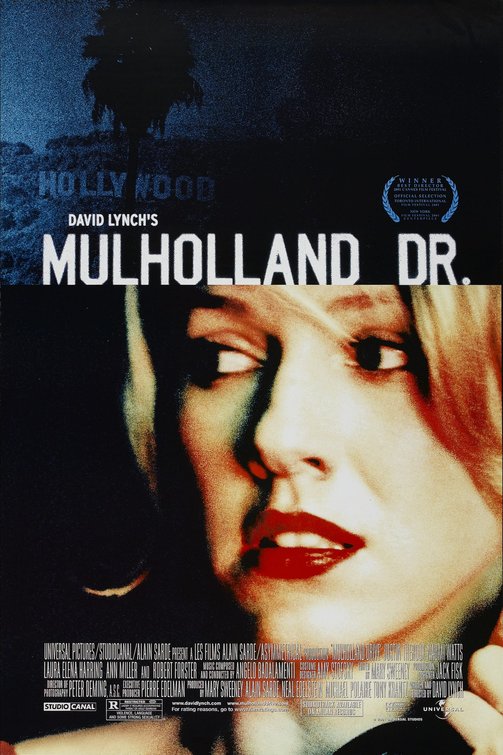
Hopefully I've demonstrated how these films form a sort of conceptual trilogy but I think they have a nice overarching narrative that tie them all together. I doubt Lynch ever intended them to work like that but they do. In Fire Walk With Me we are given a mercilessly claustrophobic small town, the seedy inverse of what we'd seen most of the time in the show. It's what would happen if we never left Frank and his goons in Blue Velvet. Laura is trapped, she's doomed to become a victim of Twin Peaks, her father and the nasty spirits surrounding both. This experience is the common frustration of many young people in small towns taken to the most hideous of extremes. The escape never comes but in a weird way Lost Highway is the escape. If Fire Walk With Me represents the imprisoning nature of where we start then Lost Highway shows the equally poisonous nature of the road in-between, quite literally. Laura suffers for staying while Fred suffers for running. Unsurprisingly then Mulholland Dr. represents the arrival and the devastating disappointment it can create. The film begins with the arrival of Rita, who may as well just have come off of the lost highway, and then we see Betty's much sunnier entrance into Hollywood. The climax of Mulholland Dr. is the most finite of the three and serves as a fitting conclusion to what began in Fire Walk With Me and Lost Highway. Taken together these three films each depict a stage in a single journey, exposing the unique nightmarish quality in each.
So, for future reference I'll call these three the 'denial trilogy' because repression could sum up pretty much all of Lynch's work. Each film shows two distinct nightmares: one is allegorical and fantastic while the other is the brutal reality the first is trying to hide. It's important not to dismiss the first as merely a figmant of a character's imagination but they clearly help to illuminate each protagonist's subconscious. Because the mysteries of the black lodge, the perilous affair with Alice and the mystery of Rita's car crash are not as horrifying as Leland's abuse, Fred's guilt and Diane's bitter jealousy. While Blue Velvet and Twin Peaks (the series) showed two shades to the same reality, the denial trilogy (sounds good doesn't it?) shows two separate realities that are both black. Confronting the darkness that is unquestionably 'real' is devastating but by filtering the corny fifties Americana that the protagonists imagine through a uniquely creepy perspective, Lynch makes sure the audience never loses sight of the dangers of repression. There is no better world in the dichotomy of each film, merely two different sorts of pain.
I feel like I should finish this post by confessing why I am really so hell bent on creating a unified experience out of these three movies. I stand by everything I've said but part of me just wants to avoid picking favourites. When someone asks me what my favorite Lynch film, or my favorite film in general is then I don't want to be forced to pick a favorite amongst these three that I really love. I'd rather just mysteriously answer The Denial Trilogy, possibly backwards, and let the confused person who posed the question try and work out exactly what that means. And that confusion will be all the explanation for why these films are so strong.
Or they could just read this stupidly long post, whatever works best.
Saturday, 26 January 2013
Review: Django Unchained
 |
| He like the way you die, boy. |
It's telling of the subject matter and it's presentation that Django has become, even by Tarantino's standards, immensely polarizing: it's artistic and moral credibility being both vigorously defended and attacked. What's also interesting is that in every review of the film I've read, both positive and negative, it's clear how hard it is for many critics to form a clear opinion. The combination of a controversial subject matter, brutal and stylized violence and frequent lapses into silliness make this a hard film to articulate personally, let alone critically. The AV Club gave a pretty good example of this mindset in this article, where the task of reviewing Django Unchained was treated like a grenade no one wanted to jump on (their metaphor not mine).
The reason for this can be attributed to this movie being Tarantino's most straightforward film since Jackie Brown while also being his most unique. The story is linear and the genre rules are mostly adhered to but it's still built around one of the most collectively repressed cultural memories in the world. So is Django Unchained cathartic? Not quite. There's scenes of confronting cruelty and ones of cartoonish violence but the film refuses to connect those dots. I can't think of a film that is so ruthless in its pursuit of exposing America's historical hypocrisy. There is not a single sympathetic Caucasian American in the film and, in another bold twist, a German expat is the film's paragon of racial harmony. Samuel L Jackson adds a further layer of depth with his extraordinary performance as the scarred but ruthlessly brutal Stephen. It's a complex take on the cringe-worthy Uncle Tom stereotype that adds a much deeper layer to the racial politics.
But for all of the cultural critique this is still a film where women get blown away by guns at absurd angles, where Tupac and James Brown can invade pre-civil war Mississippi and where every character is introduced with a beautifully absurd bump in. He may have moved on to grander subject matter but Tarantino definitely hasn't lost his schlocky sweet tooth and I, for one, am thankful for that.
These opposing sides of Django can be problematic but they never fail to provoke. Trashy genre fare is Tarantino's passion and by extension it's how he brings passion to what has become a distant subject matter. When everything is said and done he is simply too talented a filmmaker to create anything less than a thoroughly engaging movie. Django Unchained isn't a perfect movie but this can't be boiled down to a single flaw or wrong turn: it is a general uncertainty and uneasiness that accompanies exiting the theater. And ultimately I think that this is the response Tarantino was aiming for and given the subject matter, rightfully so.
Friday, 25 January 2013
Based On The Internationally Acclaimed Podcast
You know what makes us angry? Fuckin' up books with shit films. You know what makes Saro angry? Joe Wright's insipid adaptation of Atonement. You know what makes Crippy angry? Charlie Kauffman's indulgent Adaptation (as in, that's the actual title). We discuss this stuff in this... thing.
Saro's failed TV pilot.
Back when everyone was excited about the new seasons of Dexter, Homeland and Boardwalk Empire, and Crippy was in Europe; I attempted to have a weekly discussion about each episode of the shows. Despite the fact they were our most downloaded episodes I got bored talking to myself and eventually gave up. The archives of my descent into madness can be found here.
Ummm... Brick's A Classic... Right?
Brick is a far cry from a classic but that didn't stop us talking about it because quite frankly it's awesome. We also tied it into the then-upcoming release of Looper, another Ryan Johnson film. We're guessing this is the least watched of the films we discussed so we'll wait here while you go see it.
A Podcast Worthy of The Fountain
We like to think of this as the 'The Fountain' of our podcasts, misguided and undercooked, but we didn't want to chuck away a whole episode for nothing, otherwise sitting through The Fountain was for nothing. But even if we don't bother to say his whole name Darrenofsky has made some films we love... and some we really didn't.
We Meant To Post This Sooner But We Got... Tied Up
We homoerotically sigh our way through a brief (for us) look back at Hitchcock's often overlooked masterpiece Rope. The gimmicky camerawork often overshadows the powerful drama of Hitchcock's first colour film. Elements have dated but it's hard not to find one aspect that works for you. Also it's extremely gay.
A Podcast In Three Parts... or Acts!
Back in the days of Batmania (last July) nobody could shut up about Christopher Nolan, including us. In this stupidly long episode we discussed all his films, which filled us with a sense of admiration and frustration. Saro wearily defends The Dark Knight Rises while Crippy painstakingly explains the complex film metaphor of Inception. Gripping stuff!
Podcast - The Classic: Mulholland Drive
In our very first podcast we tried to unpack David Lynch's mammoth of a film, Mulholland Drive, almost breaking our brains in the process. While it's usually hard to stretch out a single film discussion into more than half an hour we managed to go on for an hour, hopelessly trying to figure out what the hell just happened. Regardless of the quality of conversation this has been our most popular film episode because you can never talk too much about David Lynch.
Subscribe to:
Posts (Atom)